Fair Play? Human Rights and the FIFA World Cup 2026
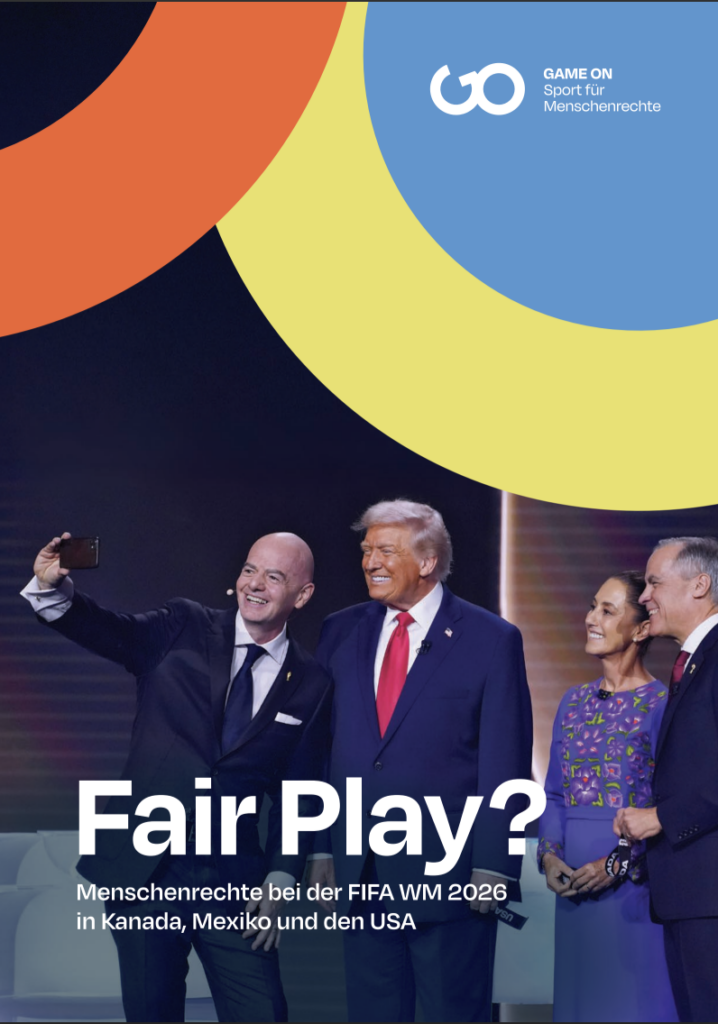
ILGA-North America and the Caribbean (ILGA-NAC) is pleased to share a recent feature in Fair Play? Human Rights and the FIFA World Cup 2026 in Canada, Mexico and the United States, published by the Vienna Institute for International Dialogue and Cooperation (VIDC) through its GAME ON! Sport for Human Rights initiative.
The publication examines a range of human rights issues connected to the FIFA World Cup 2026, including Indigenous rights, migration, civic participation, labor rights, and the experiences of LGBTQIA+ communities across the host countries.
As part of the publication, ILGA-NAC’s Executive Director, Sharon Mottley (then Regional Program Manager) was interviewed about the implications of the tournament for LGBTQIA+ communities, the current policy environment affecting LGBTQIA+ rights in North America, and the importance of ensuring that inclusion, safety, and human rights commitments are translated into meaningful action before, during, and after the tournament.
“Silence Also Sends a Message”
Interview with Sharon Mottley
According to the joint bid for the 2026 World Cup, Canada, Mexico, and the United States committed to a human rights strategy that includes non-discrimination, inclusion, and specific commitments regarding the rights of LGBTQI+ people.
During the 2025 FIFA Club World Cup in the United States, FIFA removed anti-discrimination and anti-racism messaging that had played an important role at previous tournaments.
Hanna Stepanik spoke with Sharon Mottley, Regional Program Manager for North America and the Caribbean at ILGA, the global federation of LGBTQIA organizations, about the upcoming FIFA World Cup.
How does ILGA view major sporting events?
Looking ahead to the 2026 World Cup, it is important to recognize that inclusion in sport cannot be viewed in isolation. The question is not simply whether the World Cup will be inclusive, but for whom and under what conditions.
At ILGA, we see major sporting events not only as sporting occasions, but as human rights moments that can influence visibility, safety, access, and public debate. Two-Spirit, lesbian, gay, bisexual, transgender, queer, intersex, asexual, and other LGBTQIA+ people are part of a broader ecosystem. We are not only spectators; we are also fans, workers, journalists, volunteers, and athletes.
What are the specific concerns regarding the 2026 World Cup?
One of my greatest concerns is that people may view the World Cup host locations as a single, uniform landscape. At present, the United States and Canada are not in the same place, particularly regarding the broader environment for 2SLGBTQIA+ people and especially for trans communities.
Across many U.S. states, we are witnessing active restrictions targeting trans people, particularly in sports. In many host cities there are also concerns about immigration and identification requirements that may affect how people move through these spaces, especially visitors from abroad.
Safety is not only about protection from violence. It is also about dignity, freedom of movement, how people are treated at borders, and whether they can exist in public spaces without fear. For example, what happens if your identity does not match your identification documents? And while Canada generally provides stronger protections, we are also seeing growing backlash
there. So when we ask whether this will be a safe tournament, there is no simple answer. For some people it may feel manageable. For others—particularly trans and non-binary people, racialized 2SLGBTQIA+ individuals, and migrants—the risks will be significantly greater.
What makes the 2026 tournament unique in your view?
What distinguishes this tournament from other sporting events is its scale and complexity. It spans multiple countries with very different social, political, and legal realities.
This creates risks, but it also creates opportunities to establish higher standards. A tournament of this magnitude can encourage organizers and host cities to take inclusion more seriously—not merely as a slogan, but as a lived practice.
The positive change we hope to see is deeper engagement with local civil society and 2SLGBTQIA+ organizations. Real change is practical. It means better training, stronger protections, effective reporting mechanisms, and genuine connections to communities.
Even if the progress seems modest, it would be enormously meaningful for 2SLGBTQIA+ people.
“If FIFA truly believes that football is for everyone, that commitment must be reflected through
Sharon mottley, ilga-nac executive director
clear standards, visible action, and accountability—not simply through general statements.”
FIFA has previously spoken strongly against discrimination, including homophobia and transphobia. That changed during the FIFA Club World Cup in the United States last year. How do you see FIFA’s role in the context of current restrictions on LGBTQI+ rights?
FIFA has a responsibility to be consistent in its communication about non-discrimination. It cannot speak forcefully about inclusion only when doing so is easy.
You cannot promote inclusion from a distance and then change course when you arrive at the center of political controversy in the United States. In the current global climate, where the rights of 2SLGBTQIA+ people—and especially trans people—are under pressure, silence also sends a message. Silence can be dangerous.
This is precisely when leadership matters most. If FIFA truly believes that football is for everyone, that commitment must be reflected through clear standards, visible action, and accountability—not simply through general statements.
Is there anything else you would like to add?
For us, the central question is whether this World Cup will leave a meaningful legacy—not something that merely creates the appearance of inclusion for a few weeks, but something that genuinely improves people’s lives. Ultimately, inclusion in sport should not be temporary. It should be lasting, equitable, and authentic.
“Ultimately, inclusion in sport should not be temporary. It should be lasting, equitable, and
Sharon Mottley, ilga-nac executive director
authentic.”
If the 2026 World Cup is to leave a meaningful legacy, it must go beyond visibility and produce structural change. That means investing in local communities, protecting workers and residents, and embedding accountability into the implementation of inclusion.
Read the original interview here – https://www.fairplay.or.at/fileadmin/Bibliothek/Fairplay/GAMEON_Sport_und_Menschenrechte_Brochure_A4_web_1__1_.pdf